Neelam Khan

frontend developer

HTML
CSS
TailwindCSS
JavaScript
TypeScript
React
Vue
Python
Django
Showcase
Information

About me

Frontend engineer with 2+ years building performant, accessible web products. Skilled in React, TypeScript, JavaScript, Vue, and frontend component libraries, with a track record of shipping features that measurably improve engagement, load time, and conversion. Also builds backend services in Python with Django and FastAPI, enabling end-to-end ownership of features from architecture to pixel-level polish. Thrives in fast-moving, product-driven teams.

Building

Work History

Front End Engineer

Company

Tony Blair Institute for Global Change

July 2025 - Present
  • Build responsive, accessible user interfaces using TypeScript, React, and TailwindCSS, with a strong focus on usability and performance.
  • Own and deliver end-to-end features from the frontend, collaborating with backend services built in Python, Django, and FastAPI as required.
  • Build internal AI-powered tools leveraging LLMs including Claude, ChatGPT, and Gemini; use Langfuse for prompt monitoring, evaluation, and observability across AI features.
  • Translate product and design requirements into interactive Figma prototypes and production-ready interfaces.
  • Design and maintain reusable component libraries and design systems, accelerating development and ensuring consistent UI patterns across applications.
  • Conduct code reviews to uphold engineering standards, improve code quality, and mentor junior developers.
  • Implement unit and component tests using React Testing Library and Vitest to ensure reliability and long-term maintainability.
  • Optimise frontend performance, accessibility (a11y), and cross-browser compatibility to deliver a polished user experience.
  • html
  • css
  • tailwind
  • typescript
  • react
  • python
  • django
  • fastapi
  • figma

Front End Developer

Company

The Big Phone Store

April 2024 - July 2025 | 1yr 3 months
  • Built and maintained responsive, production-grade e-commerce interfaces using TypeScript, Vue.js, Nuxt.js, and TailwindCSS, serving live customer traffic.
  • Translated Figma designs into pixel-perfect, reusable Vue components, ensuring visual and functional consistency across the platform.
  • Collaborated with backend, design, and product teams to ship end-to-end features within agile sprint cycles.
  • Improved site performance and Core Web Vitals through code splitting, lazy loading, and image optimisation.
  • Identified and resolved cross-browser and cross-device compatibility issues to ensure a consistent user experience.
  • Contributed to the team's component library, promoting reusability and reducing development time for new features.
  • Participated in code reviews and pair programming to maintain code quality and share knowledge across the team.
  • Wrote clean, maintainable code following team style guides and Git workflow best practices (branching, PRs, code review).
  • html
  • css
  • tailwind
  • javascript
  • typescript
  • react
  • vue
  • nuxt

Front End Developer Internship

Company

The Big Phone Store

Feb 2024 - April 2024 | 3 months
  • Developed an e-commerce web application independently using TypeScript, Vue.js, Nuxt.js, and TailwindCSS based on design specifications
  • Acquired proficiency in Vue.js, Nuxt.js, and TailwindCSS from self-directed learning to deliver production-ready UI within the internship duration
  • Transformed pixel-perfect designs into responsive, reusable Vue components, ensuring high fidelity to the original design
  • Integrated the application into the team's frontend development pipeline, gaining practical experience with professional workflows and tools
  • html
  • css
  • tailwind
  • javascript
  • typescript
  • vue
  • nuxt

Projects

Accessible Component Library

  • TypeScript
  • React
  • TailwindCSS

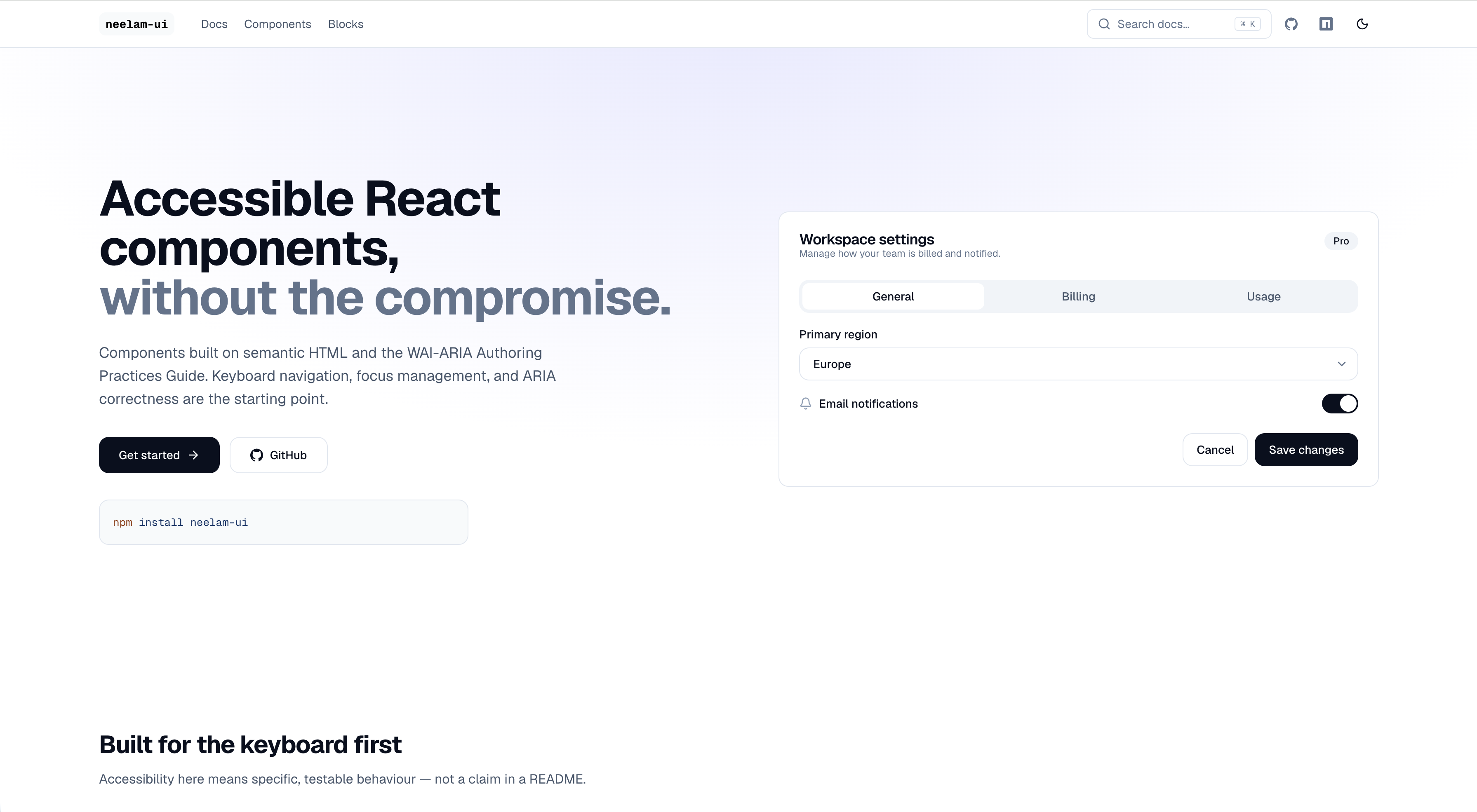
A published React component library of 40 accessible components, built to the WAI-ARIA Authoring Practices Guide and shipped to npm as @neelamkhan21/ui, with hosted Storybook documentation and accessibility testing enforced in CI.

Key Features

  • 40 components — from primitives (Button, Input, Checkbox) to composite widgets (Dialog, Combobox, Command palette, DataTable, Carousel, Calendar), each with its own Storybook stories and test suite.
  • Accessibility as the design constraint — every interactive component implements the WAI-ARIA APG pattern for its widget type: correct roles and ARIA relationships, full keyboard support, and managed focus.
  • Native platform first — Dialog is a real <dialog> driven by showModal(), so the focus trap, Escape-to-close, and top-layer stacking come from the browser rather than hand-rolled JavaScript; menus and popovers use the native Popover API.
  • Automated a11y testing in CI — every story is run against axe-core via the Storybook test runner, so an accessibility regression fails the build before it can merge.
  • Reduced-motion support — all transitions are dropped under prefers-reduced-motion (WCAG 2.3.3), including animations built to avoid non-animatable properties (open/close via a grid-template-rows 0fr↔1fr transition instead of height: auto).
  • Documented decision log — a DECISIONS.md recording the per-component accessibility reasoning: why a native element was or wasn't used, how hidden content is removed from the tab order and accessibility tree with inert, and what each ARIA relationship is doing.
  • Published and consumable — versioned on npm with dual ESM/CJS builds, generated TypeScript declarations, and MIT licensing including third-party notices for bundled dependencies.

Tech Stack

Library

  • React 19 + TypeScript, authored as a headless-leaning component API
  • Tailwind CSS 4 for styling, class-variance-authority for variant-driven component props
  • lucide-react for iconography
  • Native browser primitives — <dialog>, the Popover API, and inert — in place of JavaScript reimplementations

Documentation

  • Storybook 10 with the a11y addon, one story file per component
  • Static Storybook build deployed behind AWS CloudFront as the public documentation site

Testing

  • Vitest + React Testing Library + jest-axe for unit and accessibility assertions (40 test files)
  • Storybook test runner with axe-playwright running axe-core over every story in a real browser

Build / Distribution

  • tsup producing ESM + CJS bundles with TypeScript declaration files
  • Published to npm as a scoped public package with exports map and peer-dependency ranges for React
  • GitHub Actions CI running the unit suite, the package build, the Storybook build, and the full axe-core story sweep on every push and pull request

Skills Demonstrated

Accessibility engineering to a published specification (WAI-ARIA APG), design-system and component API design, keyboard and focus management, automated accessibility testing, npm package authoring and distribution (bundling, type declarations, licensing/compliance), documentation-driven development with Storybook, and CI pipeline configuration.

OSS Health Dashboard

  • TypeScript
  • React
  • Python
  • FastAPI
  • PostgreSQL
  • Kubernetes
  • TailwindCSS

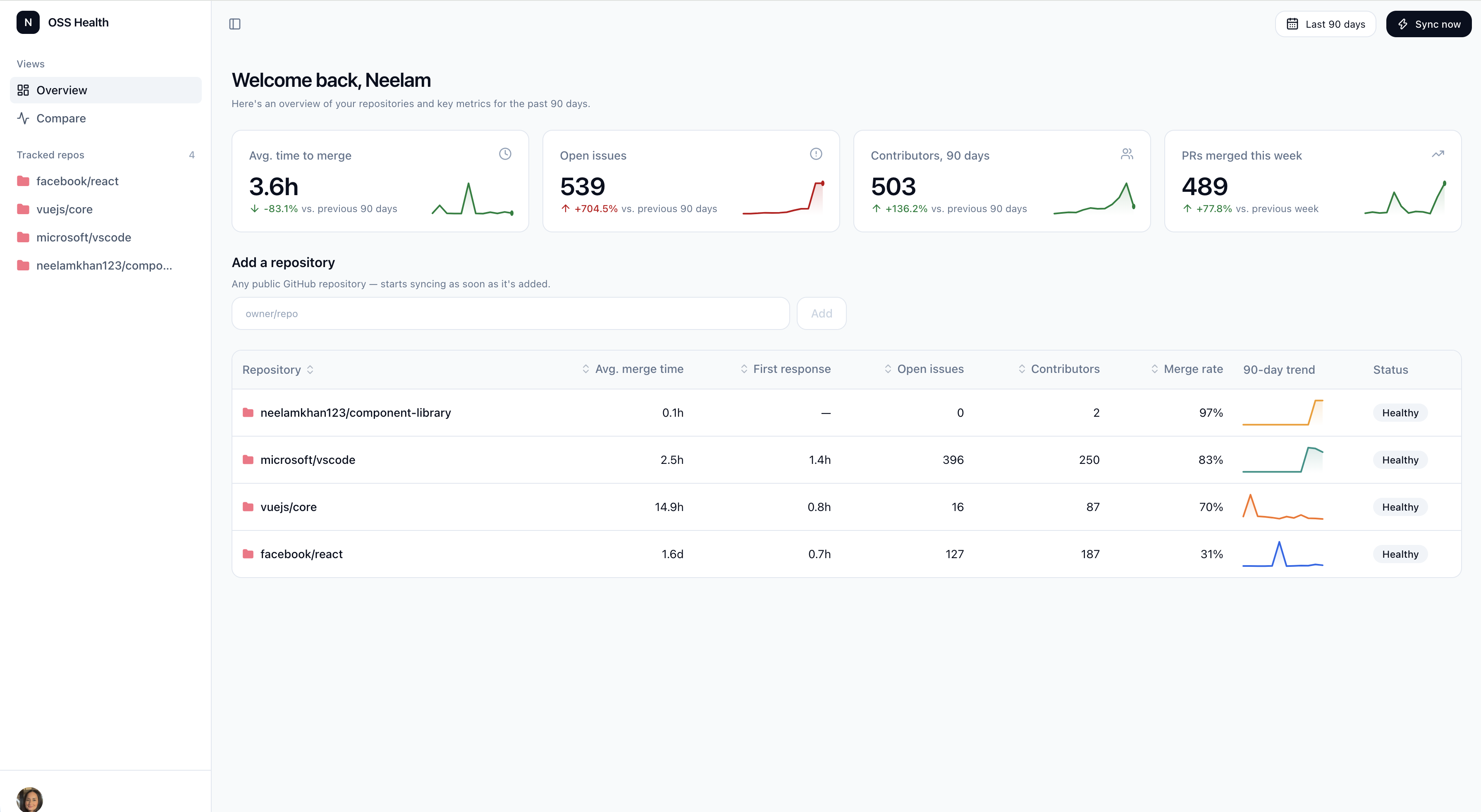
A full-stack dashboard that tracks the health of open-source repositories — syncing pull requests, issues, commits and contributors from the GitHub API on a schedule, then reporting how long PRs take to merge, whether the issue backlog is growing, and who is active. Built on my own published component library, and deployed to a real Kubernetes cluster.

Key Features

  • Scheduled ingestion pipeline — Celery beat triggers a sync every 15 minutes; a worker paginates the GitHub API across pull requests, issues, commits, contributors, reviews and issue comments, caching responses to stay well inside the rate limit.
  • Measured performance work, not asserted — every optimisation was benchmarked against ~1,000–1,800 PRs per repository and written up in PERFORMANCE.md, including the places where the expected win turned out not to exist.
  • 21x faster dashboard load — Redis caching takes the landing request from 1,510ms to 71ms at p50, and from 6.5 to 136 requests/second under concurrency.
  • 53% smaller initial bundle — route-level and chart-library code splitting cuts initial JavaScript from 782KB to 368KB, worth ~0.4s of LCP on a simulated mobile connection. Lighthouse scores 0.98 with a CLS of 0.
  • Revocable sessions by design — authentication uses opaque random tokens in Redis rather than JWTs, because a JWT is only as revocable as its expiry; sign-out is a single DEL. Sessions are httpOnly cookies, with GitHub and Google OAuth alongside email and password.
  • Real Kubernetes, not a demo — a k3s cluster running Postgres as a StatefulSet with a PersistentVolumeClaim, migrations as a one-off Job, readiness and liveness probes, rolling restarts, and horizontal pod autoscaling.
  • Cost engineering as an explicit decision — the managed-services design (RDS + ElastiCache + always-on compute) would have cost about $39/month. Moving the data tier into the cluster and the cluster onto an always-free host brought that to £0/month, with the reasoning and the trade-offs documented rather than hidden.

Tech Stack

Backend

  • FastAPI + SQLAlchemy 2.0 with Alembic migrations, running on PostgreSQL
  • Celery worker and beat scheduler over Redis, which doubles as response cache and session store
  • Opaque-token session auth with bcrypt password hashing, per-user rate limiting, and GitHub/Google OAuth

Frontend

  • React 19 + TypeScript + Vite, styled with Tailwind CSS 4
  • Built on @neelamkhan21/ui, my own published component library, consumed as a real npm dependency
  • Recharts for trend visualisation, lazy-loaded so it stays out of the initial bundle

Infrastructure

  • Docker Compose for local development, driven by a Taskfile so setup is two commands
  • Kubernetes (k3s) in production: separate Deployments for API, worker and scheduler, nginx serving the SPA and proxying the API from one origin, and Caddy terminating TLS with automatically renewed certificates
  • Multi-architecture container images (arm64 + amd64) published to Docker Hub
  • Scripted, idempotent deployments to either an always-free ARM host or an on-demand cloud instance

CI

  • GitHub Actions running the backend suite against live Postgres and Redis services, frontend lint, typecheck and build, and Lighthouse CI with asserted performance and accessibility budgets

Skills Demonstrated

Backend API design and data modelling, background job scheduling and third-party API integration, query optimisation and cache strategy backed by benchmarks, authentication and session security, Kubernetes manifest authoring and cluster operation, infrastructure automation, CI pipeline configuration, and cost-aware architecture decisions with the trade-offs written down.

Task Manager

  • TypeScript
  • React
  • TailwindCSS
  • Python
  • Django

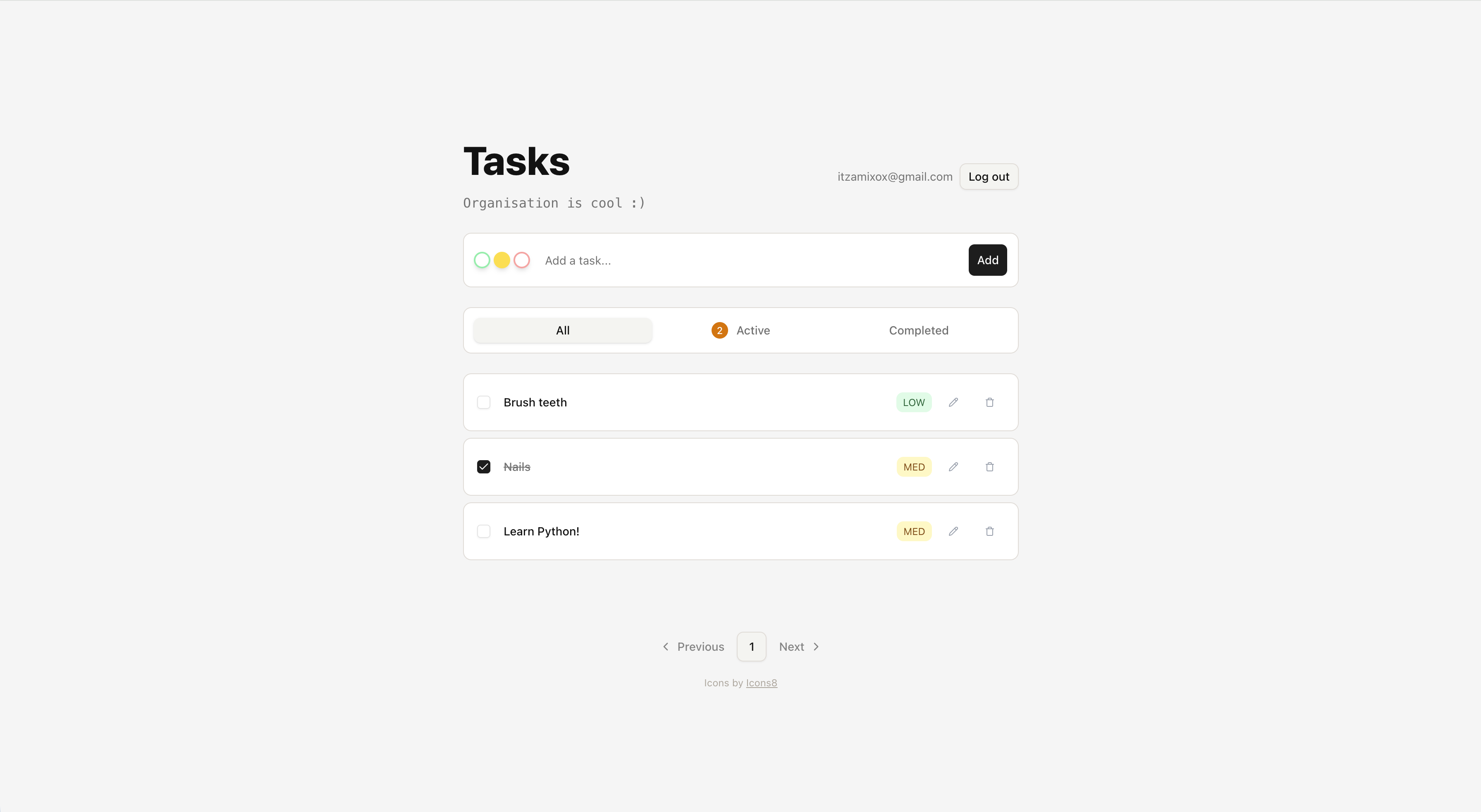
A full-stack task management application with secure authentication, priority-based organization, and a modern, responsive UI. Built as a decoupled REST API (Django) + SPA (React) architecture, deployed across two platforms (Render for the API, Vercel for the frontend).

Key Features

  • Google Sign-In (OAuth 2.0) — users authenticate with their Google account; the backend verifies the ID token server-side and issues JWTs for session management.
  • JWT-based auth — stateless authentication via djangorestframework-simplejwt, with 12-hour access tokens.
  • Per-user task ownership — each todo is scoped to its owner; the API only ever returns/mutates the authenticated user's own data.
  • Priority levels (Low/Medium/High) with a custom priority selector UI, including a data migration to remap legacy priority values.
  • Full CRUD with pagination, inline editing, and delete confirmation modals.
  • Responsive, accessible UI built with shadcn-style components on top of Base UI primitives.

Tech Stack

Frontend

  • React 19 + TypeScript, built with Vite
  • Tailwind CSS 4 for styling, class-variance-authority + tailwind-merge for variant-driven component APIs
  • shadcn/ui-pattern components on Base UI (@base-ui/react) primitives — dialogs, tabs, pagination, checkboxes, etc.
  • @react-oauth/google for Google Sign-In integration
  • sonner for toast notifications
  • ESLint 10 + typescript-eslint for linting

Backend

  • Django 6 + Django REST Framework — RESTful API with ViewSets/serializers
  • PostgreSQL (hosted on Neon), managed via dj-database-url
  • djangorestframework-simplejwt for JWT issuance/verification
  • google-auth for verifying Google OAuth ID tokens
  • django-cors-headers for cross-origin requests from the deployed frontend
  • WhiteNoise for compressed, hashed static file serving
  • Gunicorn as the production WSGI server

Testing

  • Backend: Django/DRF APITestCase with force_authenticate, covering the Todo API and Google login flow (mocked token verification)
  • Frontend: Vitest + React Testing Library + jsdom, with component-level tests for the task list, modals, and priority selector

Tooling / DevOps

  • Task automation via a Taskfile.yml (Go Task) for one-command local setup (venv, migrations, npm install) and running backend+frontend concurrently
  • Separate deploy pipelines: Render (Django API via build.sh: install deps → collectstatic → migrate) and Vercel (Vite static build)
  • TypeScript project references (tsconfig.app.json / tsconfig.node.json) for split app/tooling type-checking
  • Environment-based configuration via .env / python-dotenv

Skills Demonstrated

Full-stack development, REST API design, OAuth/JWT authentication flows, relational data modeling & migrations, responsive UI engineering with a modern component system, automated testing (unit + integration, frontend + backend), and multi-service cloud deployment/CI configuration.

The Continental Post

  • TypeScript
  • React
  • TailwindCSS
  • HTML

A full-stack news aggregation and bookmarking platform built with React Router 7 in framework mode, combining SSR-capable routing with a serverless API layer for authenticated news browsing and personal article curation.

Key Features

  • Firebase Authentication — sign up, login, and logout flow gating bookmarking and dashboard features.
  • NewsAPI integration via serverless functions — fetch, post, and delete news articles through Netlify Functions, keeping API keys off the client.
  • Topic/language search & discovery — a search engine to explore specific topics, languages, etc., plus a dedicated Discover page.
  • Personal bookmarking + dashboard — bookmark articles and view/manage them in a user dashboard, with delete support.
  • Responsive UI built with TailwindCSS across mobile and desktop.
  • Containerized deployment option via a production Dockerfile.

Tech Stack

Frontend

  • React Router 7 (framework mode) + TypeScript, built with Vite
  • TailwindCSS for styling
  • Firebase SDK for authentication

Backend / Services

  • Netlify serverless Functions acting as a lightweight API proxy/backend for NewsAPI requests
  • NewsAPI as the external news data source
  • Firebase Authentication for identity/session management

Testing

  • Jest (with Babel transform) test suite (jest.config.mjs, jest.setup.ts) for component/logic coverage

Tooling / DevOps

  • Dockerfile + .dockerignore for containerized deployment (AWS ECS, Cloud Run, Fly.io, etc.)
  • Deployed on Netlify, leveraging integrated Functions for the API layer
  • TypeScript-first configuration throughout the app

Skills Demonstrated

Serverless backend architecture, third-party REST API integration (NewsAPI), Firebase authentication flows, responsive UI engineering with React Router 7 + Tailwind, containerization, and automated testing with Jest.

Recipe Blog

  • TypeScript
  • React
  • CSS
  • HTML

A recipe discovery and management blog that lets users search, explore, save, and author their own recipes, combining a public recipe API with Firebase-backed accounts and local persistence for a fast, personalized browsing experience.

Key Features

  • Firebase Authentication — sign up, login, and logout to unlock personalized features.
  • Spoonacular API integration — search and retrieve recipe data (ingredients, steps, nutrition) from a large external recipe database.
  • Dual search experience — two independent search bars for finding recipes by different criteria.
  • Explore page — curated recipe discovery outside of direct search.
  • Full recipe detail view — name, ingredients, steps, and nutrition data per recipe.
  • User-authored recipes — add and delete your own recipes alongside API-sourced ones.
  • Bookmarking — save favorite recipes for quick access later.
  • State persistence via localStorage — keeps bookmarks and preferences across sessions without a dedicated backend.

Tech Stack

Frontend

  • React + TypeScript (~70% of codebase), built with Vite
  • CSS-based styling system (~28% of codebase) for custom, responsive layouts
  • HTML for semantic page structure

Backend / Services

  • Spoonacular API as the external recipe data source
  • Firebase Authentication for user accounts and session handling
  • Browser localStorage for lightweight client-side state persistence (no dedicated app backend)

Tooling / DevOps

  • Vite build tooling with a TypeScript project configuration
  • Static production build (dist/) deployed via Netlify

Skills Demonstrated

Frontend-focused CRUD-style UX (recipes + bookmarks), third-party REST API integration, Firebase authentication, client-side state persistence, and responsive UI/UX design with TypeScript.

+ other small projects on my GitHub

Contact me

Coded with ❤️ by Neelam
LinkedinGitHubResume